~7 min read · Poultry care
In short: A poultry brooder is a warm, enclosed space that keeps day-old chicks at 33–35°C for their first days, because chicks cannot control their own body temperature yet. Get temperature, clean water, feed, space and hygiene right in the first 14 days and most Kenyan farmers can hold chick mortality to 2–4% instead of losing 20–30% of the flock.
Two farmers buy 200 day-old chicks from the same hatchery, on the same Tuesday morning. Six weeks later, one is selling 193 healthy birds. The other counts 150 and can't understand where the money went.
I've seen this exact gap on farms in Kiambu and Nyandarua. It's almost never bad luck, and it's rarely the chicks. It's the first two weeks — the brooding period. That's where flocks are quietly won or lost, long before anyone notices a sick bird.
The good news: brooding is the most controllable part of poultry farming. You don't need a big budget. You need the right setup and a bit of discipline. Let's build it.
Table of contents
- What is a poultry brooder?
- Why do so many chicks die in the first week?
- What temperature should a chick brooder be in Kenya?
- How do I set up a brooder step by step?
- How much space, water and feeder space do chicks need
- What does a good brooder cost?
- A Kiambu example
- Key takeaways
- FAQ
- Brooding calendar for Kenya's seasons
What is a poultry brooder?
A brooder is the heated, draught-free space where you rear chicks for roughly their first three to four weeks. It replaces the warmth a mother hen would give. A brooder has four jobs: keep chicks warm, keep them dry, keep feed and clean water within reach, and keep predators and disease out.
For the first few days, a chick cannot regulate its own body temperature. If it gets cold, it stops eating, its gut health suffers and it becomes vulnerable to disease. If it overheats, it dehydrates. Either way, growth stalls. That is why the brooder — not the feed brand, not the breed — is where a Kenyan farmer's margin is really decided.
QUICK FACT: A day-old chick can't control its own body heat for about the first 5 days of life — the brooder does it for them.
Why do so many chicks die in the first week?
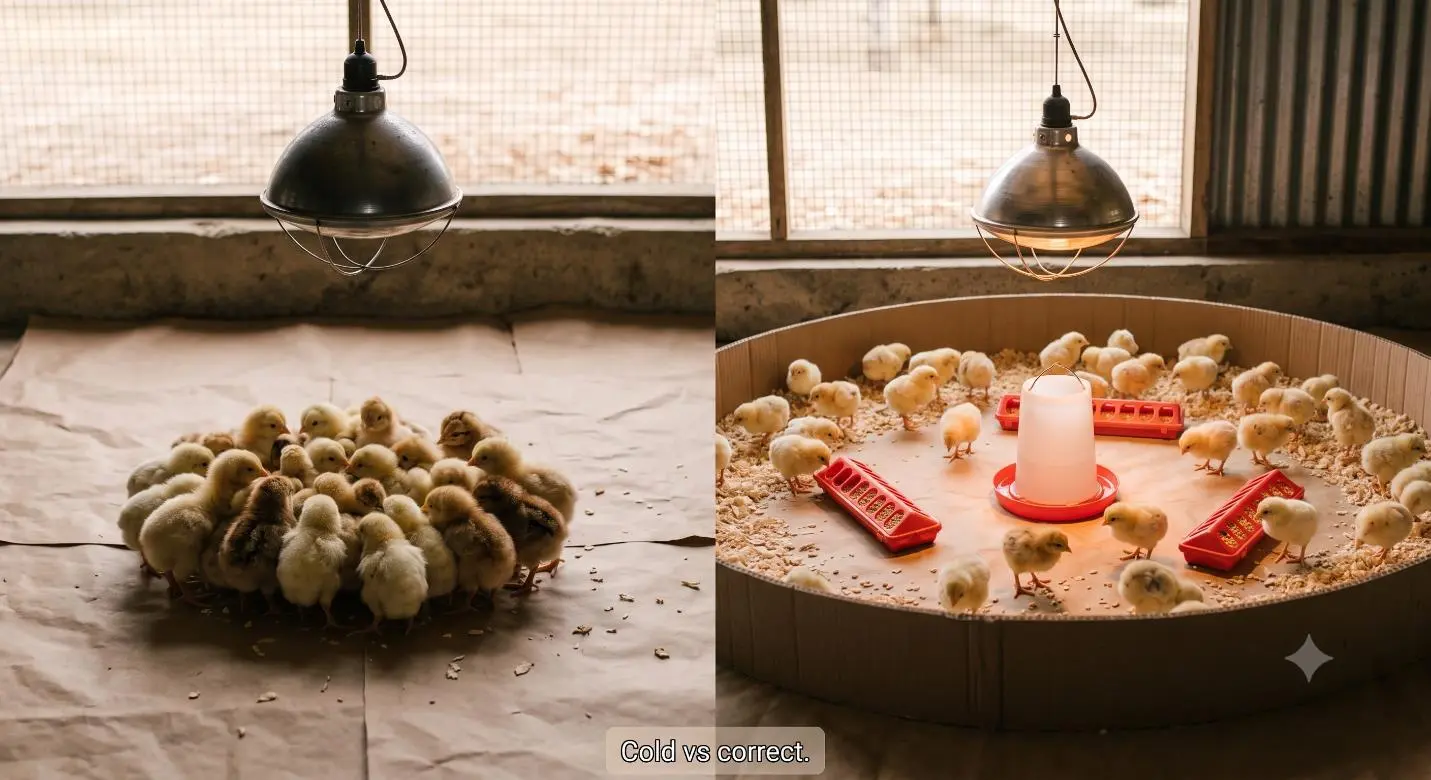
The first seven days are when a chick's organs finish developing, so stress in this window does lasting damage (Kenchic veterinary guidance, via FarmKenya/Standard). Most early deaths trace back to a short list:
- Wrong temperature. Chilled chicks huddle in a pile and smother each other; overheated chicks lie flat, pant and spread to the cool edges (FarmKenya).
- Poor start on water and feed. Chicks that don't find water and feed fast in the first 24 hours fall behind and rarely catch up.
- Wet litter breeds the organisms that cause disease.
- Weak biosecurity. New chicks brought into a shed that wasn't cleaned and rested pick up whatever the last flock left behind.
- Poor-quality chicks. A healthy day-old chick is alert, clean, standing well, with a healed navel and weighing around 38–42 g (FarmKenya). Buy from a hatchery you trust.
DID YOU KNOW? A well-managed broiler flock in Kenya should lose only 2–4% of birds. A 25% loss — one in four — is a management failure, not normal (Kenchic/FarmKenya).
What temperature should a chick brooder be in Kenya?
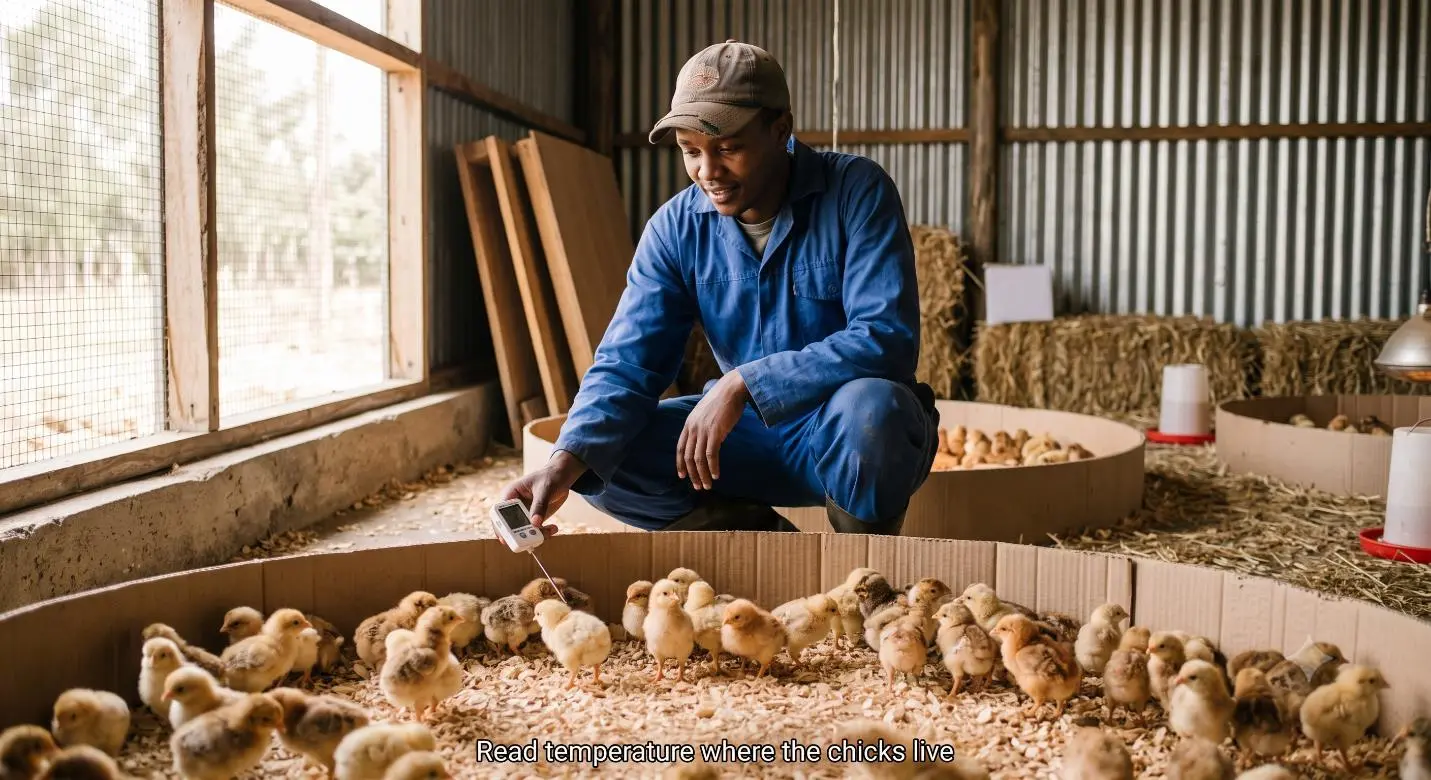
Start at 33–35°C at chick level for the first days, then step it down about 2–3°C each week until chicks are fully feathered and off heat by around week five (adjust faster in warm counties, slower in cold highlands).
Measure at chick height, not up near the bulb. And here's the trick every good brooder-keeper uses — read the chicks, not just the thermometer:
- Chicks piled under the heat, chirping loudly → too cold. Lower the bulb or add heat.
- Chicks pressed to the far walls, panting, wings out → too hot. Raise the heat source.
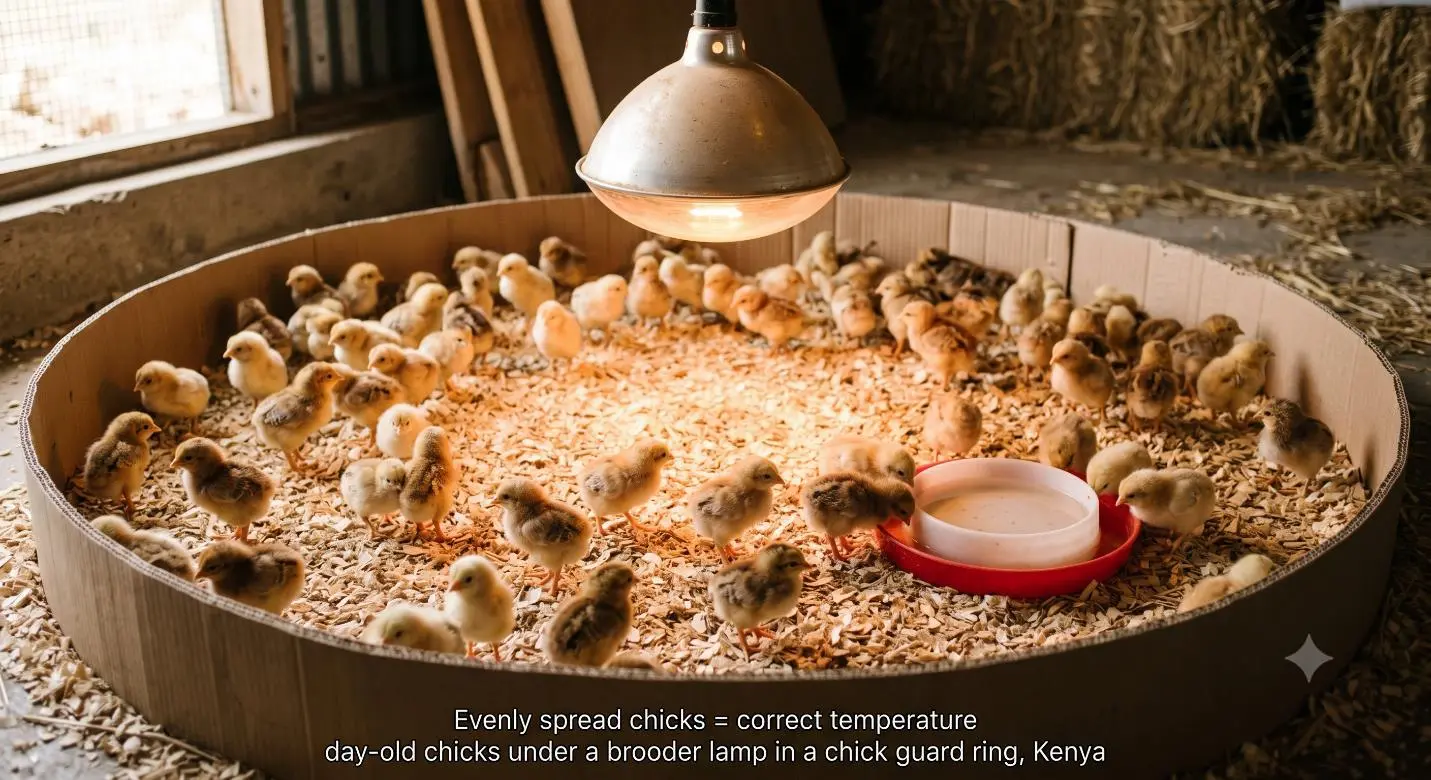
- Chicks spread evenly, some eating, soft chirping → just right.
Chick age | Target temp (°C) | What good looks like |
Day 1–3 | 33–35 | Chicks spread evenly, active, soft chirping |
Day 4–7 | 31–33 | 75%+ have full crops by 24h after placement |
Week 2 | 29–31 | Wing feathers starting to show |
Week 3 | 27–29 | Birds using the whole floor |
Week 4 | 24–27 | Begin weaning off heat (warm counties) |
Week 5+ | 21–24 / off | Fully feathered, heat off |
VETERINARY CORNER — early warning signs: Check the flock twice a day. Report to your vet if you see huddling, wheezing, unsteady walking, loss of appetite, or greenish/reddish/whitish
droppings (FarmKenya). Chicks should be vaccinated on schedule against Newcastle, Gumboro and Infectious Bronchitis — confirm the programme with your local agrovet or county vet.
How do I set up a brooder step by step?
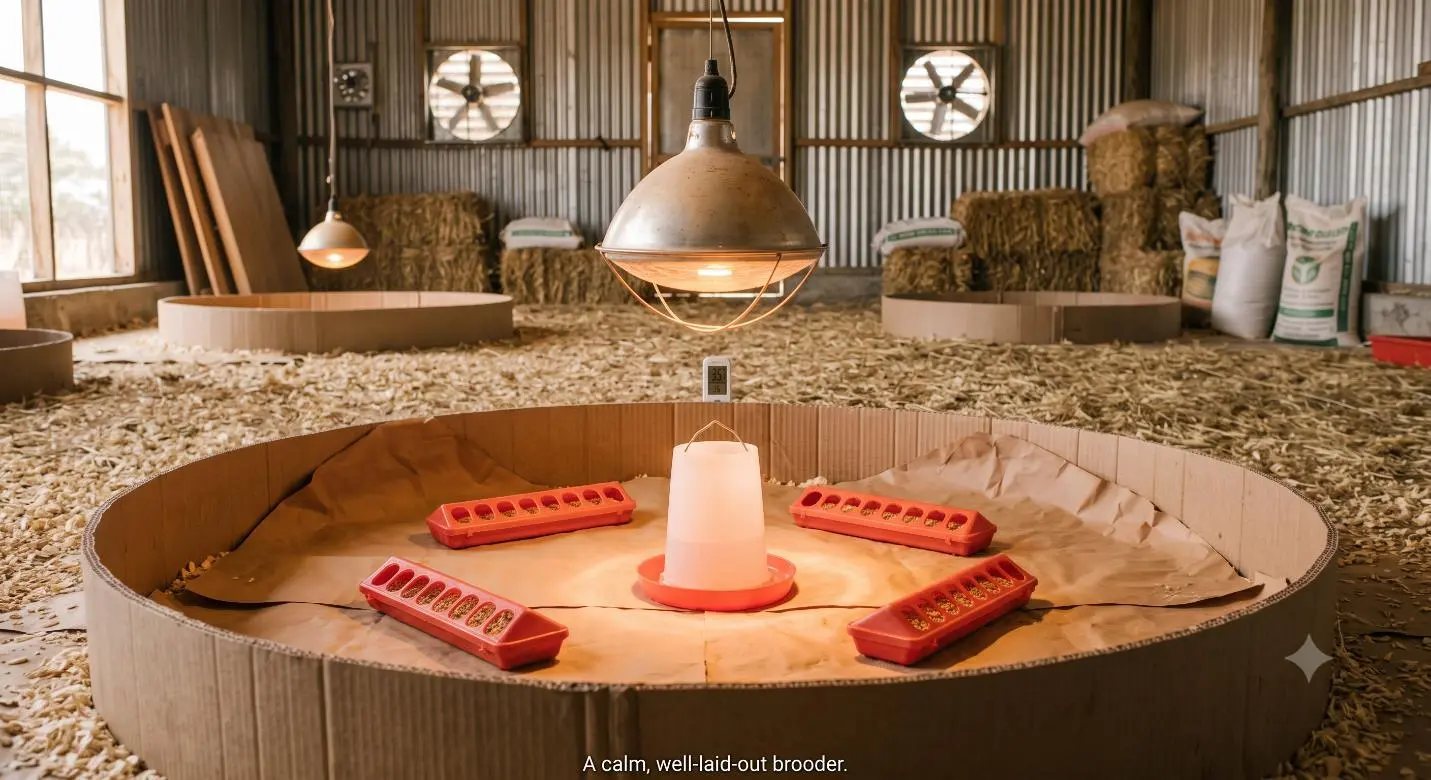
A simple, reliable setup any Kenyan farmer can copy:
- Clean and rest the shed. Wash, disinfect and let the brooding area dry and rest before chicks arrive. A good start needs a clean start.
- Lay dry litter. Spread 5–8 cm of dry wood shavings (avoid sawdust and damp litter). Cover it with paper for the first 2–3 days so chicks feed off the floor and learn where food is.
- Build a chick guard (ring). A round cardboard or hardboard ring, about 30–45 cm high, keeps chicks near the heat and removes cold corners. Expand the ring outward as they grow.
- Set the heat source and switch it on 24 hours early. Warm the brooder to 33–35°C before the chicks arrive, not after. One 150–250 W infrared bulb warms roughly 150–250 chicks (TNAU Agritech); gas or electric hovers suit larger batches.
- Place drinkers first, then feeders. Put clean water out before the chicks go in. Use small chick (baby) drinkers so day-olds can't drown, and feeder trays or paper for the first days.
- Place the chicks and let them drink first. On arrival, dip a few beaks in the water, then leave them to settle. Warm water with a little glucose in the first hours helps stressed chicks.
- Check crop fill at 24 hours. Gently feel the crops of ~10 chicks — around 75% should feel full and soft (The Poultry Site). If not, your feed or water access needs fixing.
- Keep light bright for the first 7–10 days so chicks find feed and water easily, then reduce it.
How much water and feeder space do chicks need?
Undersize any of these and mortality climbs. Use this as your shopping list for a batch of 100 chicks (scale up for bigger flocks):
Item | Rule of thumb (per 100 chicks) | Why it matters |
Brooding floor space | Start ~2 m², expand weekly | Overcrowding causes smothering, damp litter, disease |
Chick drinkers | 2–3 small (baby/1–4 L) | ~1 per 50 chicks; keeps water within a short walk |
Feeder space | Trays/feeders for ~100 chicks + paper days 1–3 | 1 feeder tray per 100 broiler chicks (The Poultry Site) |
Heat source | 1× 150–250 W infrared bulb (or hover) | Warms ~150–250 chicks (TNAU) |
Brooder thermometer | 1 minimum, read at chick level | Removes guesswork on temperature |
Chick guard ring | 1 ring around heat source | Keeps chicks near warmth, no cold corners |
EQUIPMENT SPOTLIGHT — the chick starter kit that actually moves your mortality number. You don't need everything at once, but three items earn their cost in the first batch:
- Chick (baby) drinkers — shallow so day-olds can't drown, easy to clean daily. As birds grow, an automatic Plasson-type or nipple drinker cuts labour and keeps water clean.
- Chick feeders / trays — enough feeder space that every chick eats without fighting for it.
- Brooder thermometer — the cheapest insurance you'll buy; it turns "it feels warm" into a number.
Medilink stocks chick drinkers, poultry feeders and brooder thermometers and delivers up-country. Not sure what a full brooding kit for your flock size looks like? Send your chick numbers for a tailored quote. For the drinker debate, see our guide on automatic poultry drinkers vs manual founts.
What does a good brooder cost?
Brooding equipment is cheap relative to what it protects. Consider the math for a 200-chick batch (illustrative — assume your own figures and confirm current prices):
- Assume KES 100–150 per day-old chick → KES 20,000–30,000 just in chicks.
- Losing 25% of them = ~50 chicks × ~KES 120 = ~KES 6,000 gone before you count wasted feed and the sale value of the mature birds you'll never sell.
- A basic reusable kit — chick drinkers, feeders, a thermometer, a chick guard — is a one-off cost you reuse batch after batch.
In other words, the equipment that prevents a single bad batch usually pays for itself the first time you use it. Medilink lists prices on request — send your flock size for a quote rather than guessing.
A Kiambu example
A smallholder near Githunguri was losing about a fifth of every broiler batch. Nothing exotic was wrong. The heat bulb was switched on only when the chicks arrived, the drinkers were adult-sized (day-olds struggled to reach and a few drowned), and the litter stayed damp near the door.
Three changes: warm the brooder 24 hours early, swap to shallow chick drinkers plus a thermometer read at chick level, and keep the litter dry with a proper chick guard. The next batch came in under 5% mortality. Same shed, same hatchery, same feed — better first 14 days.
Key Takeaways
- The first 14 days decide the batch. Nail brooding and mortality falls to 2–4%.
- 33–35°C to start, stepped down ~2–3°C a week — measured at chick level.
- Read the chicks: piled = cold, spread to walls/panting = hot, evenly spread = right.
- Water before feed, both before the chicks. Shallow chick drinkers stop drownings.
- Clean, rest and dry the shed between batches — biosecurity is free and powerful.
- The right cheap equipment pays for itself by preventing one bad batch.
Frequently Asked Questions
What temperature should a poultry brooder be in Kenya? Start at 33–35°C at chick level for the first days, then reduce about 2–3°C each week until chicks are fully feathered and off heat around week five. Read the chicks' behaviour, not just the thermometer.
How long do chicks need a brooder? Usually three to four weeks, until they are fully feathered and can hold their body temperature. In cold highland counties, keep heat a little longer; in warm areas, wean earlier.
How many chicks can one brooder bulb heat? A single 150–250 W infrared bulb warms roughly 150–250 chicks (TNAU Agritech). For larger flocks use gas or electric hovers, and add bulbs rather than crowding chicks under one.
Why are my chicks dying in the first week? The usual causes are wrong temperature, poor early access to water and feed, overcrowding, damp litter, weak biosecurity, or poor-quality chicks. Fix the brooder first — most early deaths start there.
What equipment do I need to start brooding? At minimum: a heat source, a chick guard ring, shallow chick drinkers, chick feeders or trays, dry litter, and a brooder thermometer. Medilink can quote a kit sized to your flock.
How do I keep chicks warm during a KPLC power cut? Have a backup heat source ready — a charcoal jiko placed safely outside the ring with good ventilation, or a gas brooder — and keep the chick guard tight to hold warmth. Never let the brooder go cold overnight in week one.
Brooding Calendar for Kenya's seasons
- Long rains (Mar–May) & short rains (Oct–Dec): Cold, damp air fights your brooder. Add heat, watch litter closely for damp, and improve ventilation without creating draughts.
- Dry & cold spells (Jun–Aug), highland counties: Coldest nights of the year — keep heat on longer and check chicks at night.
- Hot dry (Jan–Feb): Overheating risk rises. Watch for panting chicks, ensure constant cool water, and wean off heat a little earlier.
How Medilink Vet Suppliers can help
Medilink supplies the poultry equipment that protects your batch — chick drinkers, feeders, brooder thermometers and more — with delivery across Kenya and advice on sizing a kit to your flock.
📲 Get a tailored quote: WhatsApp Medilink on 0722 779774 — send your chick numbers and we'll recommend the right setup.
SOURCES & REFERENCES
Local authority first. (Confirm each link resolves before publishing.)
- State Department for Livestock / Kilimo — kilimo.go.ke — national poultry & extension guidance
- KALRO — kalro.org — poultry husbandry & indigenous chicken research
- FarmKenya / The Standard — "How to reduce mortality on your new poultry farm" (Dr James Messo, Kenchic) — standardmedia.co.ke/farmkenya/article/2001491956
- FarmKenya / The Standard — "Avoiding early chick deaths in your flock" (Dr Messo, Kenchic) — standardmedia.co.ke
- The Poultry Site — "Equipment for checking brooding set-up" — thepoultrysite.com — feeder/space ratios, crop-fill target
- TNAU Agritech Portal — Poultry Farm Equipment — agritech.tnau.ac.in — brooder capacity & heat-source specs
- Kenya Poultry Incubators Suppliers — reducing chick mortality — brooding temperature & biosecurity causes
HASHTAGS
#PoultryFarmingKenya #ChickBrooding #FormNiKufarm #PoultryKenya #KukuFarming #BrooderSetup #ChickMortality #KienyejiChicken #DairyAndPoultryKE #MedilinkVetSuppliers #PoultryEquipment #FarmingKenya